

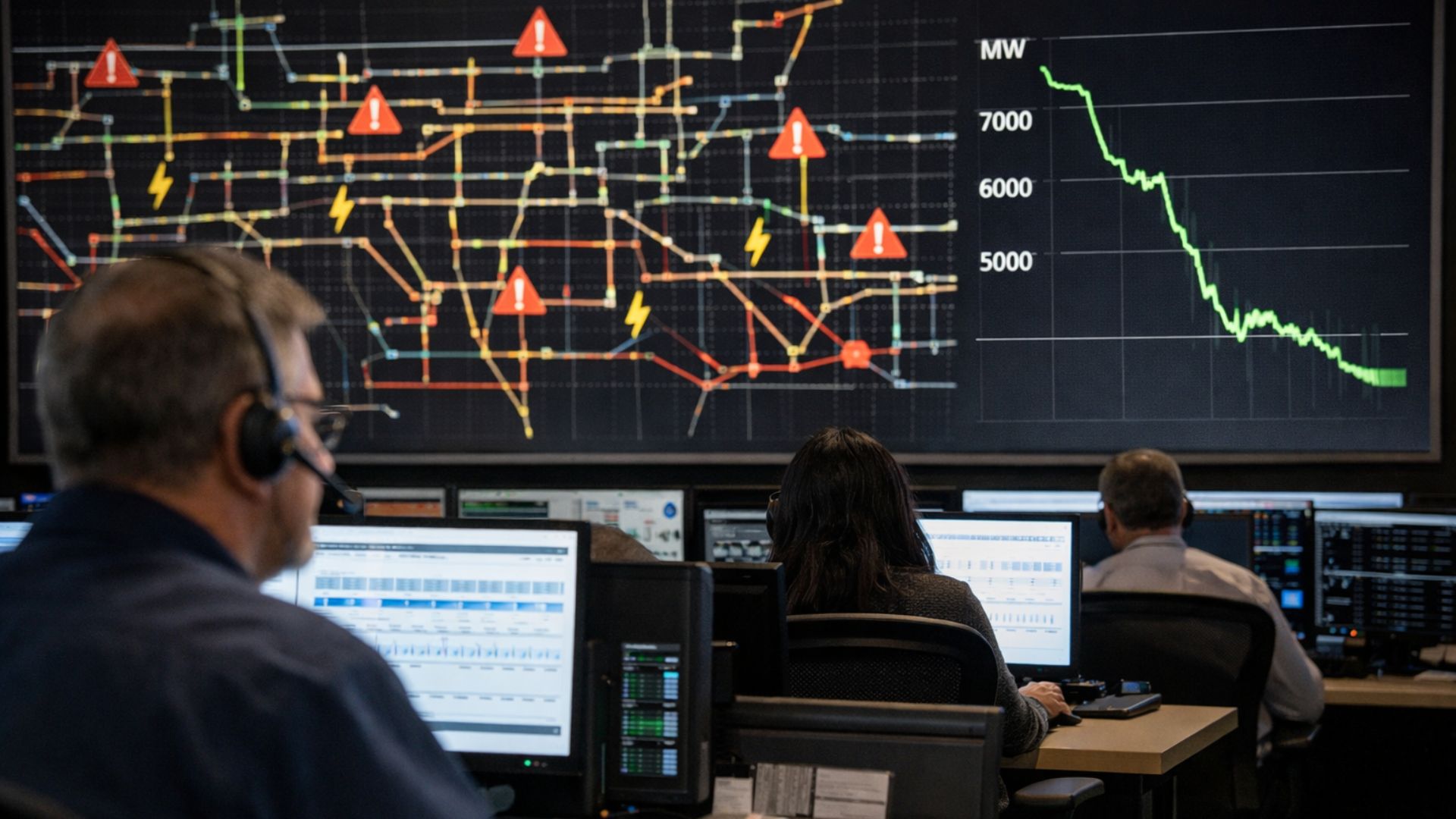







Clusters of large data centers in the United States have recently disconnected from the electricity grid at the same time during transmission disturbances, creating sudden swings in demand that challenge grid stability. The incidents have prompted regulators, utilities and technology companies to examine how growing digital infrastructure could affect power system reliability.
Key Facts At A Glance
- About 40 data centers in Virginia switched to backup power simultaneously in February 2025 after a high-voltage transmission line malfunction.
- Roughly 70 data centers disconnected in a similar event in July 2024 following another transmission line failure.
- The sudden demand drop in the February 2025 incident represented electricity roughly equal to the consumption of more than one million homes.
- PJM Interconnection, the regional grid operator, had to rapidly reduce electricity supply to maintain system balance.
- Virginia’s data centers could consume up to 57 percent of the state’s electricity by 2030.
- Data centers are projected to use as much as 17 percent of total U.S. electricity by 2030.
- Grid regulators and utilities are working with technology companies to prevent large facilities from disconnecting simultaneously during short disturbances.
Unexpected Demand Drops Challenge Grid Balance
Electricity grids must constantly balance supply and demand to maintain stable system frequency. While most planning traditionally focuses on preventing shortages of power, recent incidents involving data centers have highlighted a different risk: a sudden disappearance of large amounts of demand.
Two events in Virginia illustrated the problem. In February 2025, approximately 40 data centers abruptly switched to backup power after a high-voltage transmission line malfunctioned. The facilities had been consuming enough electricity to power more than one million homes, creating an immediate drop in demand when they disconnected.
A similar event occurred months earlier in July 2024 when about 70 data centers also withdrew from the grid following another transmission line failure. Both incidents required PJM Interconnection, the regional grid operator responsible for a multi-state electricity market, to quickly reduce generation output to avoid destabilizing the system.
The Expanding Power Footprint of Digital Infrastructure
Large data centers are increasingly among the most energy-intensive facilities connected to power grids. Operators install sophisticated monitoring systems designed to protect sensitive computing equipment from voltage disturbances or power quality issues. When irregularities are detected, many facilities automatically shift operations to on-site backup systems such as generators.
That protective mechanism can inadvertently create grid challenges when many facilities respond simultaneously. The larger the cluster of data centers within a region, the greater the potential shock to the grid if they disconnect at once.
The issue is particularly significant in Virginia, which hosts the world’s largest concentration of data centers. Projections indicate that these facilities could account for as much as 57 percent of the state’s electricity consumption by 2030, reflecting the rapid expansion of cloud computing and artificial intelligence infrastructure.
Rising Concern Among Regulators and Grid Operators
Energy regulators and grid operators are increasingly focused on how the rapid growth of large digital loads could affect system reliability. The PJM region, which spans 13 states from New Jersey to Kentucky, has already been managing concerns about whether power generation will keep pace with data-center demand growth.
Now operators must also prepare for the opposite scenario: large customers disconnecting unexpectedly. Even though the recent Virginia incidents involved less than 2,000 megawatts of lost demand and did not trigger emergencies, officials say the potential scale of future disruptions is a concern.
Former Federal Energy Regulatory Commission chairman Mark Christie has warned that massive electricity users could introduce new forms of reliability risk if their demand changes abruptly. Grid operators must be able to quickly adjust power generation to avoid oversupply conditions that could damage equipment or trigger outages.
Industry Response and Reliability Efforts
Utilities and regulators are now working with technology companies to address the issue. Dominion Energy, which serves the northern Virginia region often referred to as “data center alley,” operates transmission infrastructure involved in the incidents and is collaborating with operators to examine ways facilities might remain connected during brief disturbances.
The North American Electric Reliability Corporation, which oversees reliability standards for the U.S. grid, has also begun studying the risk. The organization has convened discussions with technology companies and data center developers to explore operational changes that could reduce the likelihood of simultaneous disconnections.
Similar concerns are emerging beyond the PJM region. In Texas, the Electric Reliability Council of Texas has already observed comparable issues involving cryptocurrency mining facilities disconnecting during grid disturbances. As more data centers are planned in the state, the grid operator is evaluating strategies to manage the risk.
The broader context is the rapid rise of electricity demand from computing infrastructure. Projections from the Electric Power Research Institute indicate that data centers could consume up to 17 percent of U.S. electricity by 2030, compared with about 4 to 5 percent today. As that share grows, grid operators say coordination between energy systems and large digital facilities will become increasingly important.