

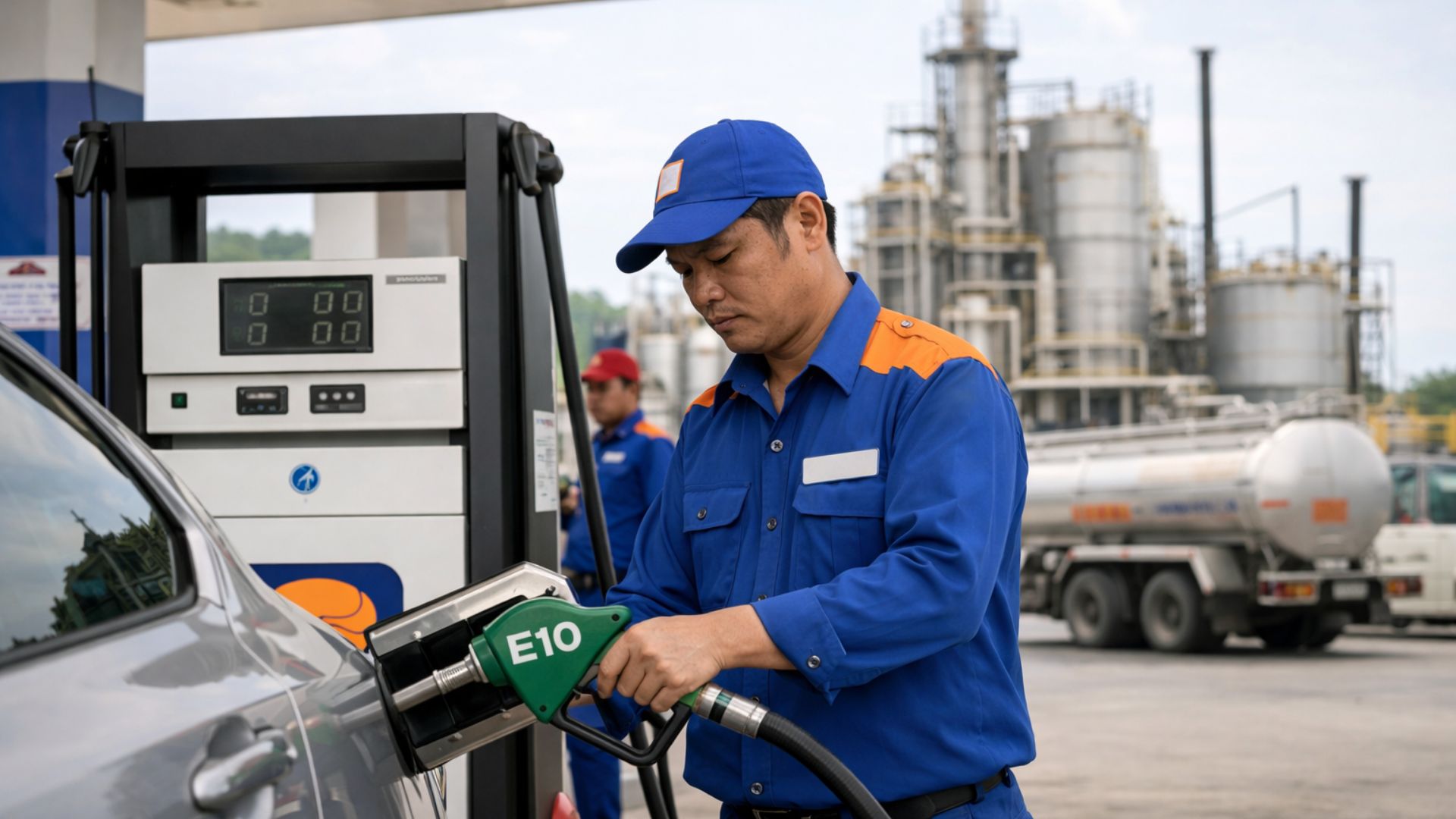







Vietnam’s Prime Minister Pham Minh Chinh issued Directive No. 09/CT-TTg on March 19, 2026, ordering the acceleration of the national E10 bioethanol fuel transition from the previously planned June 1 date to April 2026, targeting a 10 percent reduction in conventional gasoline consumption. State-owned distributor Vietnam National Petroleum Group (Petrolimex) and Vietnam Oil Corporation (PVOIL) have confirmed operational readiness across their blending infrastructure and station networks, and the Binh Son Refining and Petrochemical Joint Stock Company’s Dung Quat refinery is preparing its first 60,000-tonne ethanol batch for blending by end of March.
The directive follows Politburo Conclusion No. 14-KL/TW dated March 20 on fuel supply and price stability, and positions the E10 transition as Vietnam’s structural response to the Hormuz-driven supply disruption still ongoing as of the date of this report.
Key Facts At A Glance
- Prime Minister Pham Minh Chinh issued Directive No. 09/CT-TTg on March 19, 2026, ordering an accelerated E10 transition from June 1 to April 2026
- E10 is a blend of 90 percent mineral gasoline and 10 percent ethanol; the government targets a 10 percent reduction in conventional gasoline consumption through the transition
- Petrolimex is piloting E10RON95-III at 60 stations in Ho Chi Minh City and Quang Ngai, with daily supply approximately 40 percent above initial rollout levels
- Vietnam Oil Corporation (PVOIL) has upgraded blending and storage systems at 13 key depots nationwide
- Binh Son Refining and Petrochemical Joint Stock Company (Dung Quat refinery) is set to receive approximately 60,000 tonnes of ethanol from the Central Biofuels Plant by end of March 2026 for E10 blending
- Vietnam’s six domestic ethanol plants can cover approximately 40 percent of E10 blending demand at full capacity; the remaining 60 percent requires imports
- Ethanol is subject to lower environmental protection taxes and excise taxes than conventional gasoline, providing a potential downward pricing effect at the pump
Vietnam’s Accelerated E10 Transition
Vietnam’s Prime Minister Pham Minh Chinh signed Directive No. 09/CT-TTg on March 19, 2026, instructing the Ministry of Industry and Trade to advance the nationwide rollout of E10 bioethanol gasoline to April 2026, two months ahead of the June 1 date established under Ministry of Industry and Trade Circular No. 50/2025/TT-BCT. The directive explicitly targets a 10 percent reduction in conventional gasoline consumption through the transition and forms part of a broader package of energy security measures issued in response to the Strait of Hormuz supply disruption triggered by the US-Israel conflict with Iran beginning February 28, 2026.
The E10 directive arrived one day before the Vietnamese Politburo issued Conclusion No. 14-KL/TW on March 20, which directed the government at the highest political level to ensure no fuel shortage occurs under any circumstances. Prime Minister Chinh convened a Government Standing Committee meeting on March 21 to review implementation of both documents. Vietnamese officials stated that the energy situation is currently under control, with domestic fuel prices maintained below regional averages, but acknowledged that the stabilization fund’s reserves require a state budget advance to sustain price support through mid-April.
Industry Readiness And Supply Chain Status
Vietnam National Petroleum Group (Petrolimex), the country’s dominant fuel distributor with over 2,800 stations nationwide, has been piloting E10RON95-III gasoline since late 2025 at 60 stations in Ho Chi Minh City and Quang Ngai. Daily E10 supply volumes at pilot stations are now approximately 40 percent above initial rollout levels, with no quality complaints recorded. Petrolimex has indicated a phased full transition could begin in late April or early May across its entire system.
Vietnam Oil Corporation (PVOIL), the second major distributor with nearly 900 stations nationwide, confirmed that it has completed upgrades to blending and storage systems at 13 key depots and can process E10 blending for third-party distributors in addition to its own network. Both companies cited more than 10 years of experience distributing E5RON92 gasoline as the operational baseline for the E10 scale-up.
On the supply side, Binh Son Refining and Petrochemical Joint Stock Company, which operates the Dung Quat refinery, stated it expects to receive approximately 60,000 tonnes of ethanol from the Central Biofuels Plant by end of March 2026, which it will blend into E10 gasoline for the domestic market. The Central Biofuels Plant, a PetroVietnam facility, began trial operations on January 20, 2026 and produced its first fuel ethanol batch on February 6, 2026.
The Supply Gap And The Import Dependency Risk
Vietnam currently has six operating ethanol production facilities, but only approximately three are operational and none at full capacity. At maximum capacity across all facilities, domestic ethanol production would meet roughly 40 percent of E10 blending demand, leaving approximately 60 percent to be covered by imports, primarily from the United States and South America. Vietnam’s ethanol import lines are not routed through the Strait of Hormuz, making ethanol supply less vulnerable to the current disruption than crude oil imports. The seasonal availability of cassava as a primary feedstock requires producers to stockpile raw materials and substitute with corn during off-season periods, introducing a secondary supply management constraint.
Bui Ngoc Bao, Chairman of the Vietnam Petroleum Association, stated on March 22 that accelerating biofuel adoption helps create stable demand for agricultural products, reduces environmental pollution, and lowers dependence on fossil fuels. Industry observers have also noted that ethanol is currently priced lower than conventional gasoline in the Vietnamese market, and that E10’s lower excise and environmental protection tax rates relative to mineral gasoline could exert downward pressure on retail pump prices.
Policy And Grid-Level Context
The E10 directive is part of a layered government response that includes Vietnam’s Resolution No. 36/NQ-CP of March 6, 2026, which introduced flexible intra-week fuel price adjustment mechanisms; Decree No. 72/2026/ND-CP of March 9, which reduced import tariffs on petroleum products to 0 percent through April 30, 2026; a national energy security task force; and the state budget advance to the Fuel Price Stabilization Fund approved in principle on March 20. Directive No. 09 also includes provisions for developing EV charging infrastructure, eliminating inefficient lighting from the market by Q3 2026, and requiring the Ministry of Industry and Trade to reduce power losses in the transmission and distribution system before Q4 2026.
Vietnam’s electricity system faces compounding pressure. Coal-fired and gas turbine plants are facing fuel shortages linked to Middle Eastern supply disruptions, and new energy sources including offshore wind cannot compensate at the pace required. The directive’s instruction that domestic refineries maintain at least 70 percent of fuel demand coverage reflects continued reliance on the two operational refineries, Dung Quat and Nghi Son, for baseline fuel supply security, even as feedstock sourcing from non-Middle Eastern crude is being negotiated with Japan and South Korea.