

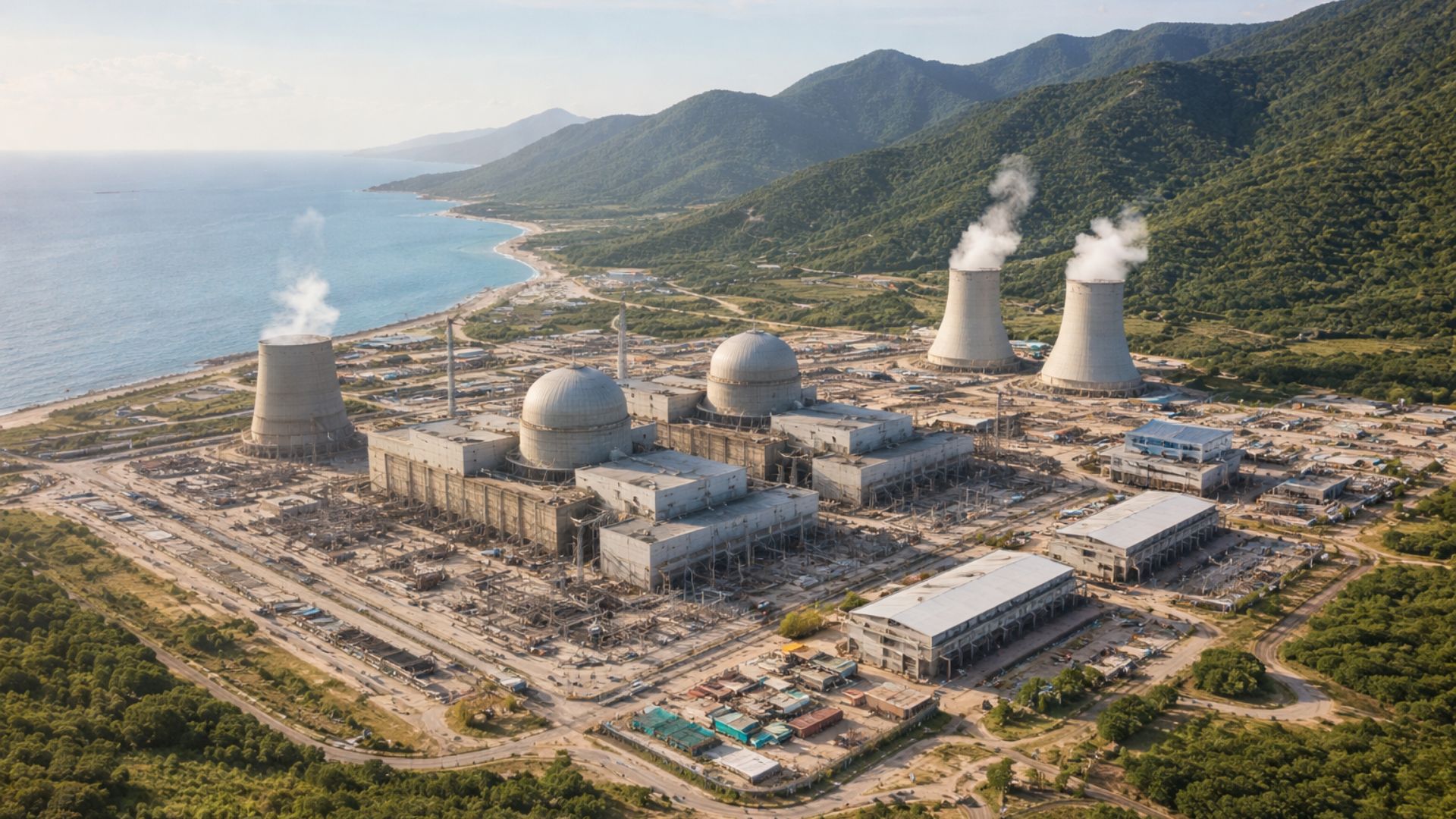







Vietnam and Russia signed an intergovernmental agreement on March 23, 2026, formalizing cooperation for construction of Vietnam’s first commercial nuclear power plant; the deal marks the revival of a project first conceived in 2009 and suspended in 2016. The agreement covers two VVER-1200 reactors with a combined installed capacity of 2,400 MW at the Ninh Thuan 1 site in Phuoc Dinh commune, Thuan Nam district, and was reached against the backdrop of a regional energy security emergency driven by the Hormuz closure.
Key Facts At A Glance
- Agreement signed March 23, 2026, in Moscow during Vietnamese Prime Minister Pham Minh Chinh’s official visit to Russia
- Signatories: Rosatom Director General Alexey Likhachev and Tran Van Son, Minister and Head of the Office of the Government of Vietnam
- Signing witnessed by Vietnamese Prime Minister Pham Minh Chinh and Russian Prime Minister Mikhail Mishustin
- Plant design: two VVER-1200 pressurized water reactors based on the Leningrad II reference design, combined installed capacity of 2,400 MW
- Site: Ninh Thuan 1, Phuoc Dinh commune, Thuan Nam district, central Vietnam
- Vietnam’s target is to commission the first units by 2030–2031; no formal construction start date has been announced
- Vietnam revived its nuclear programme through a National Assembly resolution in November 2024 after a 2016 suspension citing economic conditions and post-Fukushima safety concerns
- Japan declined participation in the companion Ninh Thuan 2 project in January 2026, citing tight construction timelines; France, South Korea, and the United States are reported to be expressing interest in that site
Vietnam and Russia formalized one of the most consequential bilateral energy agreements in Southeast Asia’s recent history on March 23, 2026, signing an intergovernmental framework for the construction of the Ninh Thuan 1 Nuclear Power Plant. The signing took place in Moscow during Vietnamese Prime Minister Pham Minh Chinh’s official state visit, with both prime ministers present as witnesses.
The agreement was signed by Rosatom Director General Alexey Likhachev and Tran Van Son, Minister and Head of the Office of the Government of the Socialist Republic of Vietnam. Rosatom stated the document establishes the necessary legal framework for the plant’s construction and will shape the direction of Russian-Vietnamese cooperation in the nuclear field for decades. Likhachev described it as the foundation for a long-term industrial partnership that would strengthen Vietnam’s energy independence. Russian Prime Minister Mikhail Mishustin said the plant’s creation would give a strong impetus to cooperation in adjacent areas including high technologies and fundamental and applied research.
A Project Long In The Making
Vietnam has considered nuclear power since 1995. In 2009, the National Assembly approved in principle the construction of two nuclear power plants in Ninh Thuan province with a combined capacity of approximately 4,000 MW. Russia was selected for Ninh Thuan 1 and Japan for Ninh Thuan 2. Considerable preparatory work was carried out at the site, including relocation of two villages and infrastructure upgrades. In October 2010, an earlier intergovernmental agreement was signed with Atomstroyexport to build using VVER-1000 reactors; this was updated in 2014 to the more advanced VVER-1200 design.
Both projects were formally suspended in November 2016, when the National Assembly cited budget constraints and safety concerns following the 2011 Fukushima Daiichi accident. The decision was later widely characterized as a missed opportunity as energy demand in Vietnam grew well ahead of forecasts.
The 2024 Revival And Japan’s Withdrawal
Vietnam formally revived its nuclear programme at the National Assembly’s 8th working session in November 2024, citing energy security imperatives, industrial development targets, and the country’s commitment to net-zero emissions by 2050. The Revised Power Development Plan 8, approved in April 2025, included nuclear power as a national strategic priority for the first time. Vietnam’s new Atomic Energy Law, passed in June 2025 and effective January 2026, established an updated IAEA-aligned regulatory framework.
Vietnam re-engaged both Russia and Japan regarding the original projects. However, in January 2026, Japan formally declined participation in Ninh Thuan 2, citing what it described as an unrealistically tight construction timeline. Reports indicate France, South Korea, and the United States have since expressed interest in the Ninh Thuan 2 contract.
The March 23 Agreement And What It Contains
Rosatom stated the agreement regulates the conditions and key areas of cooperation between the parties in implementing the Ninh Thuan 1 project, designating the Leningrad NPP-2 units 1 and 2 as the reference design. The VVER-1200 is a Generation III+ pressurized water reactor featuring passive safety systems designed to operate without active cooling for 72 hours following a loss-of-power event. Rosatom has deployed this reactor design in Bangladesh, Turkey, Egypt, Hungary, and India.
The two reactors are expected to deliver a combined 2,400 MW of baseload capacity. Vietnam’s prime minister previously set a target to complete construction of the two plants by the end of 2030, though no formal construction start date, engineering contract, or financing arrangement has been announced. Following the signing ceremony, Deputy Minister of Industry and Trade Nguyen Hoang Long and Rosatom Deputy Director General Nikolay Spassky held a working session to finalize the next implementation steps.
Also on the sidelines of the Moscow visit, Russian LNG producer Novatek signed a preliminary LNG supply agreement with an unnamed Vietnamese buyer, with Novatek’s CEO indicating deliveries could begin shortly. Broader oil and gas cooperation agreements between the two governments were also reported. The combined energy deals underscore Russia’s use of the Hormuz crisis to deepen commercial energy ties with an import-dependent Southeast Asian economy.
Why The Hormuz Crisis Sharpened Urgency
The agreement was signed amid the most severe energy supply disruption in modern history. The closure of the Strait of Hormuz since late February 2026, following the US-Israeli military campaign against Iran, has halted passage of approximately 20 percent of global oil and LNG trade. Vietnam, which holds fewer than 20 days of known petroleum reserves, has been among the most exposed ASEAN economies to the supply shock. Petrol prices in Vietnam have risen by around 50 percent and diesel by approximately 70 percent since the start of the conflict.
Nuclear energy is immune to the LNG and crude supply disruptions driving the current crisis. A 2,400 MW baseload facility with domestic fuel storage would, once operational, materially reduce Vietnam’s exposure to global hydrocarbon markets. The strategic timing of the signing reflects both Hanoi’s long-term energy planning and an acute near-term calculation about import dependence.
Geopolitical Dimensions
The agreement deepens Vietnam’s energy dependency on Russia at a time when Hanoi is simultaneously working to diversify its diplomatic and trade relationships. Vietnam and Russia have maintained bilateral ties since 1950, and Russia remains a key arms supplier to Hanoi. However, Vietnam’s trade with Russia represents a fraction of its trade with China and the United States. Critics may note that a Russian-built, Russian-fueled nuclear plant creates multi-decade supply chain dependency on Rosatom, including for nuclear fuel, technical support, and potentially waste management. No information on project financing or fuel supply terms has been publicly disclosed.