

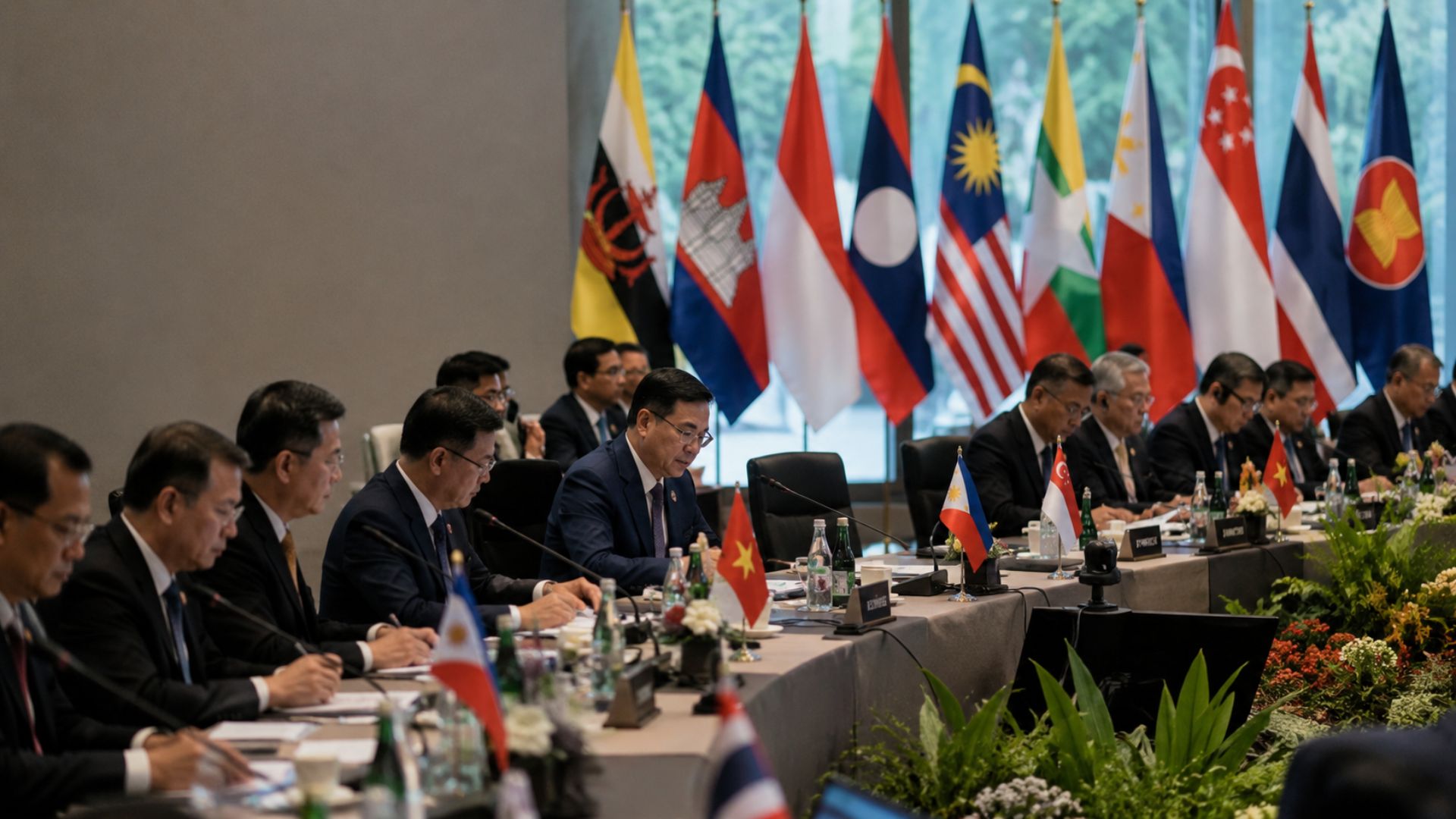







The 48th ASEAN Summit, held 7–8 May 2026 in Cebu, Philippines, placed energy supply security at the center of all formal proceedings, with member states urging swift ratification of the ASEAN Petroleum Security Agreement as the Strait of Hormuz blockade continues to constrain fuel supplies across the region. The summit’s outcome documents and working drafts called for unimpeded passage through the Strait, good-faith negotiations to end the US-Iran war, and the earliest possible entry into force of a regional fuel-sharing framework that has existed on paper for decades but has never been formally invoked.
Key Facts At A Glance
- The 48th ASEAN Summit ran from 7–8 May 2026 at Mactan Island in Cebu, Philippines, under the chairmanship of President Ferdinand Marcos Jr. and the theme “Navigating Our Future, Together.”
- Energy and food supply security were designated the top agenda items, driven by the Strait of Hormuz blockade that began on 4 March 2026 following US-Israeli military strikes on Iran on 28 February.
- Up to 84 percent of crude oil and 83 percent of LNG destined for Asia transited the Strait of Hormuz before the blockade, according to the US Energy Information Administration.
- The Philippines, as 2026 ASEAN chair, pushed to fast-track the ASEAN Petroleum Security Agreement (APSA), under which a member state can request emergency fuel assistance when domestic supply falls at least 10 percent below normal requirements for 30 continuous days.
- A working draft of the leaders’ joint declaration called for the “earliest possible entry into force” of the fuel-sharing pact on a voluntary, commercial basis.
- The summit also tabled a Submarine Power Cable Framework intended to accelerate
- ASEAN Power Grid interconnection as a structural hedge against future fuel supply disruptions.
- The summit was shortened from five to three days under a directive from President Marcos to scale back costs, with some preparatory meetings shifted to virtual formats.
Energy Security As The Summit’s Singular Focus
The 48th ASEAN Summit convened under conditions the bloc’s diplomatic establishment has not faced in its nearly six-decade history: a protracted blockade of the world’s most critical petroleum chokepoint, directly affecting supply chains for all eleven member states. Philippine Foreign Affairs Secretary Ma. Theresa Lazaro, addressing the ASEAN Foreign Ministers’ Meeting on 7 May, stated that “developments beyond our region can have immediate and profound effects on ASEAN.” ASEAN Economic Ministers, in a joint statement issued ahead of the summit, said that “the development of a consolidated regional strategy is crucial to ensure coherent and timely responses” and called for diversifying energy sources, expanding renewables, and reinforcing the ASEAN Power Grid and Trans-ASEAN Gas Pipeline.
APSA And The Fuel-Sharing Debate
The central energy deliverable pursued by the Philippines was ratification of the ASEAN Petroleum Security Agreement. Under APSA, a member state experiencing a critical shortfall in petroleum supply — defined as a deficit of at least 10 percent of normal domestic requirements sustained for at least 30 days — can issue a distress notice to the ASEAN Council on Petroleum and request assistance from other members. The mechanism requires the distressed country to first implement demand restraint measures including fuel switching and price surge protection before formal assistance can be requested.
The Philippines and its co-chair ASEAN Economic Ministers had already agreed in March 2026 to accelerate APSA’s completion ahead of the Cebu summit. The working draft of the leaders’ declaration explicitly urged “swift progress to ratify” the pact and called for preserving “the unimpeded flow of energy and essential goods” as a matter of regional economic stability. The bloc also acknowledged that APSA, which has existed in some form for decades, has never been formally invoked, a structural gap that former Philippine diplomat Laura del Rosario noted would likely force the bloc beyond rhetoric given the scale of the current shock.
Submarine Power Cable Framework And Grid Integration
Alongside the petroleum agreement, the Philippines tabled a Submarine Power Cable Framework at the summit, aimed at accelerating the long-stalled ASEAN Power Grid initiative by enabling cross-border electricity trade through subsea cable infrastructure. Singapore, which has committed to importing 6 gigawatts of low-carbon electricity by 2035, has been among the region’s most active advocates for grid interconnection as a structural buffer against LNG price volatility. Singapore Prime Minister Lawrence Wong, whose ministry stated ahead of the summit that leaders would “discuss ways to accelerate the region’s green energy transition,” attended the 8 May plenary alongside Indonesian President Prabowo Subianto, Malaysian Prime Minister Anwar Ibrahim, and other heads of government.
The ASEAN Power Grid’s relevance to the current crisis is structural rather than immediate: even an accelerated timeline would require years of construction and regulatory alignment before cross-border renewable flows could meaningfully displace imported fossil fuel volumes. Nevertheless, the summit’s emphasis on both short-term fuel sharing and longer-term grid integration signals that ASEAN’s crisis response is framed across two distinct time horizons.
Sideline Dynamics
The summit’s margins carried their own energy-relevant subtext. President Marcos convened a special meeting of the BIMP-EAGA grouping — Brunei, Indonesia, Malaysia, and the Philippines — on 7 May, a forum where cross-border power and energy infrastructure projects are regularly advanced. Marcos also met newly appointed Vietnamese Prime Minister Le Minh Hung in a bilateral session covering trade and supply chain resilience alongside rice trade mechanisms.
Senator Imee Marcos, speaking before the summit, separately called for activating APSA, closer real-time information sharing on oil reserves and supply risks, and accelerated intra-ASEAN crude and refined petroleum product trade as structural measures to reduce dependence on Middle Eastern imports.