

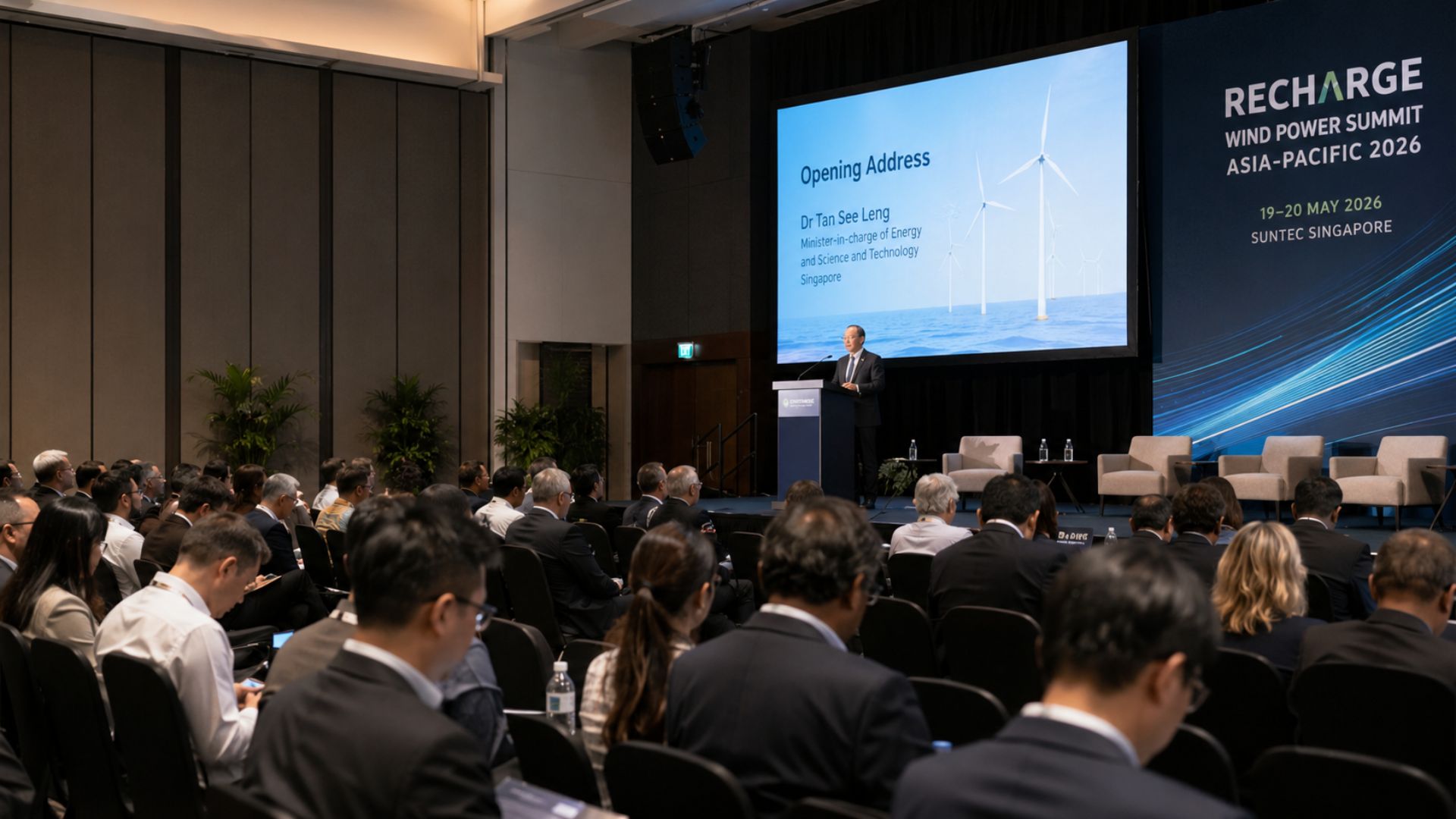







Singapore’s Ministry of Trade and Industry used the inaugural RECHARGE Wind Power Summit Asia-Pacific 2026 to announce three new institutional initiatives targeting offshore wind supply chain capacity, AI-driven maritime engineering, and floating offshore wind technology, as the government positions the city-state as the operational and knowledge hub for Asia-Pacific’s fast-expanding wind energy market. The two-day summit, held May 19 to 20 at Suntec Singapore Convention and Exhibition Centre, marked the first time WindEnergy Hamburg has convened outside Europe in its history.
Key Facts At A Glance
- The RECHARGE Wind Power Summit Asia-Pacific 2026 took place May 19 to 20, 2026, at Suntec Singapore Convention and Exhibition Centre, co-organized by WindEnergy Hamburg and DN Media Group’s RECHARGE publication.
- Global new wind energy capacity grew 40 percent in 2025, reaching the highest annual installation level on record; total installed global capacity now stands at nearly 1,300 gigawatts.
- Global wind capacity is projected to grow at a 5.2 percent compound annual growth rate over the next five years; Asia is expected to account for 60 percent or more of new onshore installations.
- Singapore’s Minister-in-charge of Energy and Science and Technology Dr. Tan See Leng announced the refreshed Marine and Offshore Energy Industry Digital Plan, developed by Enterprise Singapore and the Infocomm Media Development Authority.
- Singapore’s Technology Centre for Offshore and Marine and the NUS AI Institute are launching CATALYST, an Enterprise Singapore-supported initiative to develop AI models tailored for the marine and offshore energy sector.
- The Technology Centre for Offshore and Marine and Japan’s Floating Offshore Wind Technology Research Association signed a Memorandum of Understanding to advance floating offshore wind technologies.
- Singapore has committed to hosting a series of WindEnergy events through 2029, with a full three-day WindEnergy Asia-Pacific powered by RECHARGE flagship fair planned for 2027.
The first Asia-Pacific edition of the RECHARGE Wind Power Summit opened in Singapore on May 19 against a backdrop of intensifying geopolitical pressure on fossil fuel supply chains and accelerating offshore wind deployment across the region. Minister-in-charge of Energy and Science and Technology Dr. Tan See Leng delivered the opening address, framing the summit’s arrival in Singapore as both a strategic statement by the global industry and a moment of institutional commitment by the Singapore government.
Dr. Tan opened by noting that global new wind energy capacity grew by 40 percent in 2025, reaching a record high and bringing total installed wind capacity to nearly 1,300 gigawatts. He characterized this trajectory not as a self-sustaining trend but as one that requires deliberate policy, financing, and industrial capacity decisions to be maintained at the pace the energy transition demands.
Singapore’s Three-Pillar Wind Strategy
Dr. Tan outlined Singapore’s contribution to global offshore wind development across three areas: capabilities, innovation, and collaboration. He acknowledged that Singapore lacks commercially viable domestic wind, hydro, or sufficient solar resources, framing the city-state’s strategic role as an engineering, technology, and knowledge services hub for offshore wind projects developed elsewhere in the region and globally.
On capabilities, the minister highlighted the existing roles of Singapore’s marine and offshore engineering companies in global offshore wind projects. Seatrium Limited was cited as being on track to deliver over 16 gigawatts of offshore substation capacity across Europe, the United States, and Asia-Pacific, drawing on decades of oil and gas fabrication and marine engineering expertise. Marco Polo Marine was noted for deploying a vessel currently supporting offshore windfarm construction operations in Asia.
The minister announced the launch of the refreshed Marine and Offshore Energy Industry Digital Plan, developed by Enterprise Singapore and the Infocomm Media Development Authority. The plan targets the adoption of digital and AI tools across product design, operations management, and asset monitoring to raise the productivity and international competitiveness of Singapore’s marine and offshore energy engineering sector.
CATALYST Initiative And Floating Wind MOU
On innovation, Dr. Tan announced that the Technology Centre for Offshore and Marine and the NUS AI Institute are launching CATALYST, a new initiative supported by Enterprise Singapore. CATALYST will develop AI models tailored for the marine and offshore energy sector, with two primary applications: AI-enabled virtual test environments that shorten vessel and offshore structure design cycles and reduce testing costs, particularly for small and medium enterprises operating within a sandbox environment before committing capital; and an AI-enabled digital twin platform for marine and offshore asset operators to achieve predictive maintenance and reduce unplanned downtime.
On collaboration, Dr. Tan announced that the Technology Centre for Offshore and Marine and Japan’s Floating Offshore Wind Technology Research Association have signed a Memorandum of Understanding to jointly advance floating offshore wind technologies. Floating offshore wind is particularly relevant to Asia-Pacific markets where shallow-water fixed-foundation sites are limited. The partnership combines Singapore’s marine engineering systems integration expertise with Japan’s sustained floating wind research and pilot project experience.
Dr. Tan also noted that Enterprise Singapore has convened a Joint Working Group contributing to IEC TC 88, the International Electrotechnical Commission technical committee on wind energy generation systems, covering turbine design standards, site assessment, power quality, and simulation technologies.
Context: Asia-Pacific Wind Market Acceleration
The summit’s debut in Singapore coincides with a period of increased urgency in Southeast Asian energy planning. The ongoing Strait of Hormuz disruption has exposed the depth of the region’s dependence on imported fossil fuels, particularly liquefied natural gas and oil, and has increased the strategic premium on domestic and regionally sourced renewable energy. Vietnam, the Philippines, and Indonesia are each developing offshore wind pipeline projects that collectively represent tens of gigawatts of potential capacity, though financing constraints, regulatory frameworks, and grid connection timelines remain significant obstacles to deployment.
The summit’s organizers have confirmed Singapore as the base for a series of wind energy events through 2029. The 2026 edition is a two-day conference and exhibition format; the 2027 event will expand to a three-day WindEnergy Asia-Pacific powered by RECHARGE flagship fair, signaling both commercial confidence in the regional market and Singapore’s sustained institutional role as the regional convening venue.
Dr. Tan closed by noting that two forces are reshaping the energy transition simultaneously: escalating urgency as geopolitical tensions expose the fragility of fossil-fuel-dependent systems, and accelerating opportunity as offshore wind technology matures and costs fall. He stated that the question facing the industry is not whether wind energy will grow, but whether it will grow at the pace and scale the transition demands.