

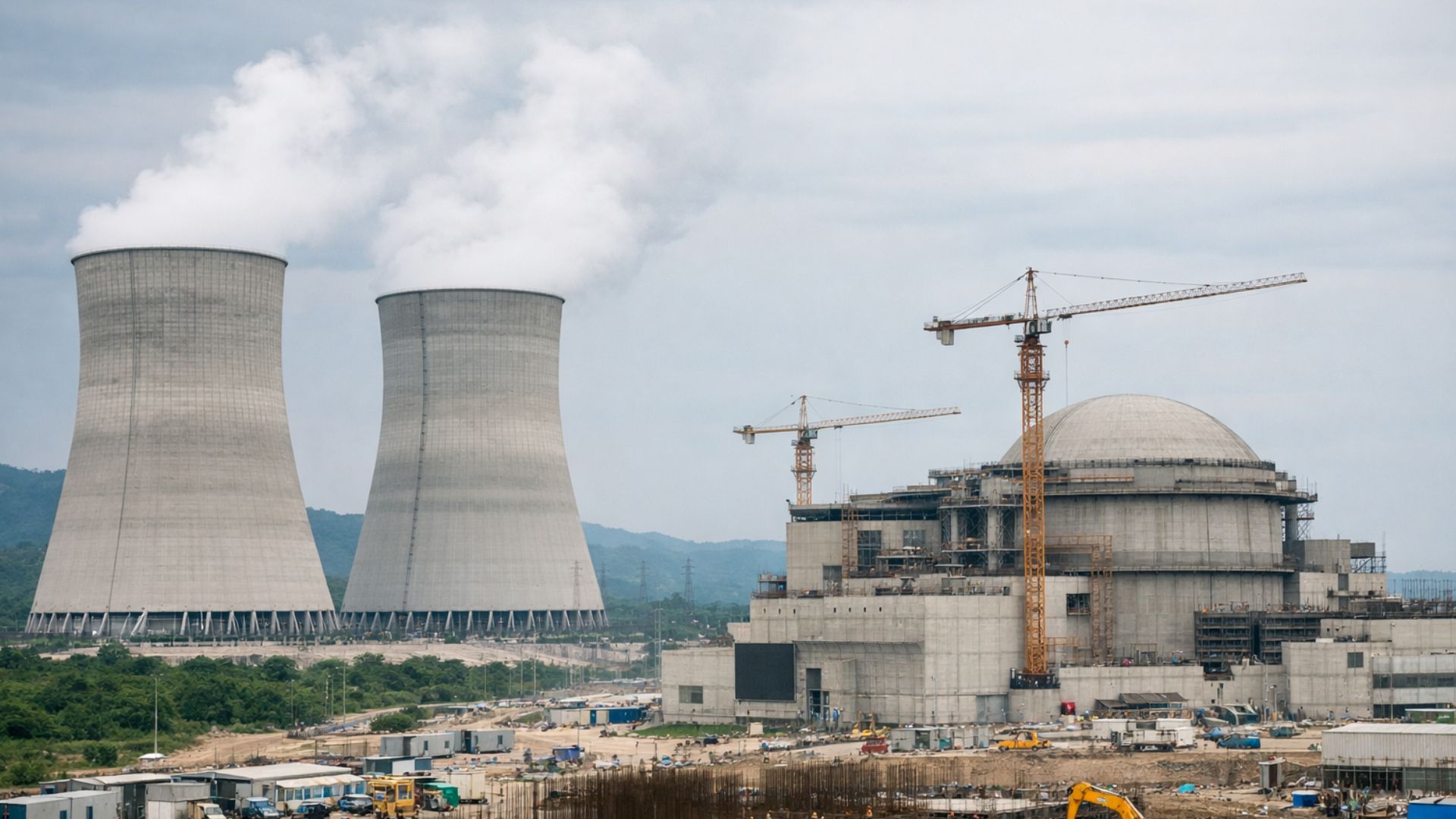







Southeast Asia’s five most active nuclear aspirants — Vietnam, Indonesia, Thailand, the Philippines, and Malaysia — have entered a period of overlapping policy commitments, regulatory actions, and bilateral agreements that represent the most concentrated burst of nuclear momentum the region has ever produced, driven in part by the energy security shock triggered by the closure of the Strait of Hormuz in late February 2026.
Key Facts At A Glance
- Five of ASEAN’s eleven member states are actively pursuing nuclear energy programs: Vietnam, Indonesia, Thailand, the Philippines, and Malaysia.
- Vietnam signed an intergovernmental agreement with Russia on March 23, 2026, for construction of the Ninh Thuan 1 plant, featuring two VVER-1200 reactors with a combined 2,400 MW capacity.
- Indonesia is targeting two small modular reactors by 2034; Canada and Russia have both submitted formal cooperation proposals.
- Thailand set a 600-MW nuclear capacity target by 2037.
- The Philippines launched a nuclear regulatory authority in 2025, approved an investor roadmap in February 2026, and set a 2032 commissioning target.
- Southeast Asia is projected by the World Nuclear Association to account for nearly one-fourth of the 157 GW expected from first-time nuclear nations by mid-century.
- The IEA projects Southeast Asia will account for a quarter of global energy demand growth by 2035, with more than 2,000 data centers already operational across six countries in the region.
The Regional Calculus Shifts
For decades, nuclear power in Southeast Asia existed primarily as policy aspiration. The region never brought a single commercial reactor online. A combination of cost overruns, safety concerns following Fukushima, and the relative availability of gas and coal had kept most proposals inert. Two developments — one long-building, one sudden — have changed that calculus.
The long-building pressure is electricity demand. Southeast Asia will account for a quarter of global energy demand growth by 2035, according to the International Energy Agency. A large share of that growth is concentrated in data centers, of which more than 2,000 are already operational across Indonesia, Malaysia, Singapore, Thailand, Vietnam, and the Philippines. A standard AI data center consumes as much electricity as 100,000 households, the IEA notes, and Malaysia alone has more than 500 operational facilities, with more in the pipeline as it competes to become the region’s AI computing hub.
The sudden pressure is the Hormuz crisis. The closure of the Strait of Hormuz following the US-Israeli strikes on Iran in late February 2026 immediately exposed how dependent the region is on fuel that transits a single maritime chokepoint. Approximately 84 percent of the crude oil and 83 percent of the LNG that passed through the Strait in 2024 was bound for Asia, according to the US Energy Information Administration. For countries whose electricity systems run primarily on imported gas and coal, that dependence is now a live vulnerability rather than a theoretical one. Analysts have noted that the Iran war has sharpened the sense of urgency for alternatives, and nuclear — which produces no fuel import dependence once a plant is built and fueled — sits at the center of that conversation.
Vietnam’s Formal Commitment
Vietnam is the furthest along. On March 23, 2026, Vietnamese Prime Minister Pham Minh Chinh signed an intergovernmental agreement with Russian counterpart Mikhail Mishustin in Moscow, formalizing Rosatom as the constructor of the Ninh Thuan 1 nuclear power plant. The plant will feature two VVER-1200 pressurized water reactors with a combined installed capacity of 2,400 MW, modeled on Russia’s Leningrad NPP-2. Rosatom Director General Alexey Likhachev and Tran Van Son, Minister and Head of Vietnam’s Office of the Government, signed the agreement in the presence of both prime ministers.
Vietnam has been considering nuclear power since the mid-1990s. Firm plans for Ninh Thuan 1 and a second plant, Ninh Thuan 2, were approved as early as 2009 and canceled in 2016 on cost and safety grounds. In December 2024, Prime Minister Chinh announced the government had put forward a proposal to restart the program. Japan, which had been assigned Ninh Thuan 2, withdrew in late 2025, citing timeline concerns. Russia remains. Vietnam’s revised atomic energy law took effect in January 2026, providing updated legal infrastructure for the program.
Separately, Russia’s largest LNG producer Novatek signed a preliminary LNG supply agreement with a Vietnamese buyer during the same Moscow visit, and the two governments also signed an oil and gas cooperation agreement. A feasibility study for a Russian-designed nuclear science and technology center in Vietnam, which will include a research reactor, is expected to be completed in April 2026. Vietnam’s target is to have Ninh Thuan 1 operational before the end of 2031.
The Philippines: Regulatory Architecture And A 2032 Target
No ASEAN country has a longer nuclear history than the Philippines. The Bataan Nuclear Power Plant was completed in the 1970s but never commissioned, becoming one of the most cited examples of sunk nuclear infrastructure in the developing world. The current Marcos administration has moved to rehabilitate the concept rather than the specific facility.
The Philippines launched a new atomic energy regulatory authority in 2025 and approved a nuclear energy roadmap for potential investors in February 2026, setting a 2032 target for commissioning the country’s first nuclear plant. The country has signed a 123 Agreement with the United States, enabling bilateral cooperation on nuclear technology and materials under non-proliferation safeguards. Alvie Asuncion-Astronomo of the Philippine Nuclear Research Institute has noted that the Hormuz crisis is strengthening the political case for non-imported power sources, and that the surge in global oil and LNG prices has added urgency to nuclear efforts.
In the immediate term, the Philippines is managing its power sector under a declared state of national energy emergency. Energy Secretary Sharon Garin has directed generation companies to maintain 15-day fuel inventories and explore coal blending and higher biodiesel blends as interim cost mitigation measures, while the grid operates under special dispatch protocols following the suspension of the Wholesale Electricity Spot Market on March 26.
Indonesia: SMR Pathway And Competing Suitors
Indonesia’s nuclear push is oriented toward small modular reactors. The government added nuclear to its national energy plan in 2025, targeting the deployment of two SMRs by 2034. Officials have confirmed that both Canada and Russia have submitted formal cooperation proposals, with others expected to follow. Indonesia’s approach reflects a preference for modular, lower-capital-commitment technology over large conventional reactors.
The country is also managing a structural energy transition under the pressure of the current crisis. Indonesia halted diesel imports in early 2026 following the completion of the Balikpapan Refinery Development Master Plan, which expanded crude processing capacity to 360,000 barrels per day. While this provides a degree of insulation on the diesel side, Indonesia continues to import crude oil and LNG, and its generous fuel subsidies — covering 30 to 40 percent of the retail price of petrol and diesel — are under fiscal strain as crude oil has risen above $100 per barrel against a budget assumption of $70.
Thailand: A Modest But Formal Target
Thailand set a target in 2025 of adding 600 MW of nuclear generating capacity by 2037. Officials with the Electricity Generating Authority of Thailand have publicly described nuclear as a promising solution for meeting rising demand affordably and cleanly. The target remains modest relative to Vietnam’s or Indonesia’s ambitions but constitutes a formal policy commitment, which is itself a departure from previous Thai postures on nuclear energy.
Thailand is currently managing a parallel fuel crisis. Its Oil Fuel Fund exhausted subsidy capacity and triggered a 6-baht-per-liter fuel price increase on March 26. The government is promoting B20 biodiesel and has approved targeted transport subsidies effective April 1 to cushion logistics operators.
Malaysia And The Data Center Driver
Malaysia has not committed to a nuclear construction timeline but is actively exploring nuclear as a power source specifically for its rapidly expanding data center sector. The country has signed a 123 Agreement with the United States, has more than 500 operational data centers, and has drawn investment from Microsoft, Google, and Nvidia as it positions itself as Southeast Asia’s AI computing hub.
Economy Minister Akmal Nasrullah Mohd Nasir stated on March 15 that Malaysia must accelerate its National Energy Transition Roadmap, particularly solar and hydropower, as immediate responses to the Hormuz crisis. The nuclear conversation in Malaysia runs in parallel — oriented toward the medium term and driven primarily by industrial power demand rather than by emergency energy security.
Structural Context And Constraints
The regional nuclear momentum is real but faces several structural constraints that analysts have noted. Bridget Woodman of the Zero Carbon Analytics research group has observed that nuclear can appear more attractive during energy crises than other options, while the risks — including accident potential and the institutional complexity of starting a nuclear industry from scratch — remain. No ASEAN nation has a domestic nuclear supply chain. All would require decades-long relationships with foreign reactor vendors, fuel suppliers, and trained operational workforces.
The World Nuclear Association estimates Southeast Asia will account for nearly a fourth of the 157 GW expected from first-time nuclear nations by mid-century. King Lee of the association has stated that momentum in the region is now at a level that is qualitatively different from previous cycles of interest. The convergence of AI-driven power demand, the Hormuz-triggered fuel security shock, and a generation of policymakers for whom climate commitments and energy security are simultaneous rather than competing pressures has produced a regional policy environment that is more hospitable to nuclear commitments than any prior period.