

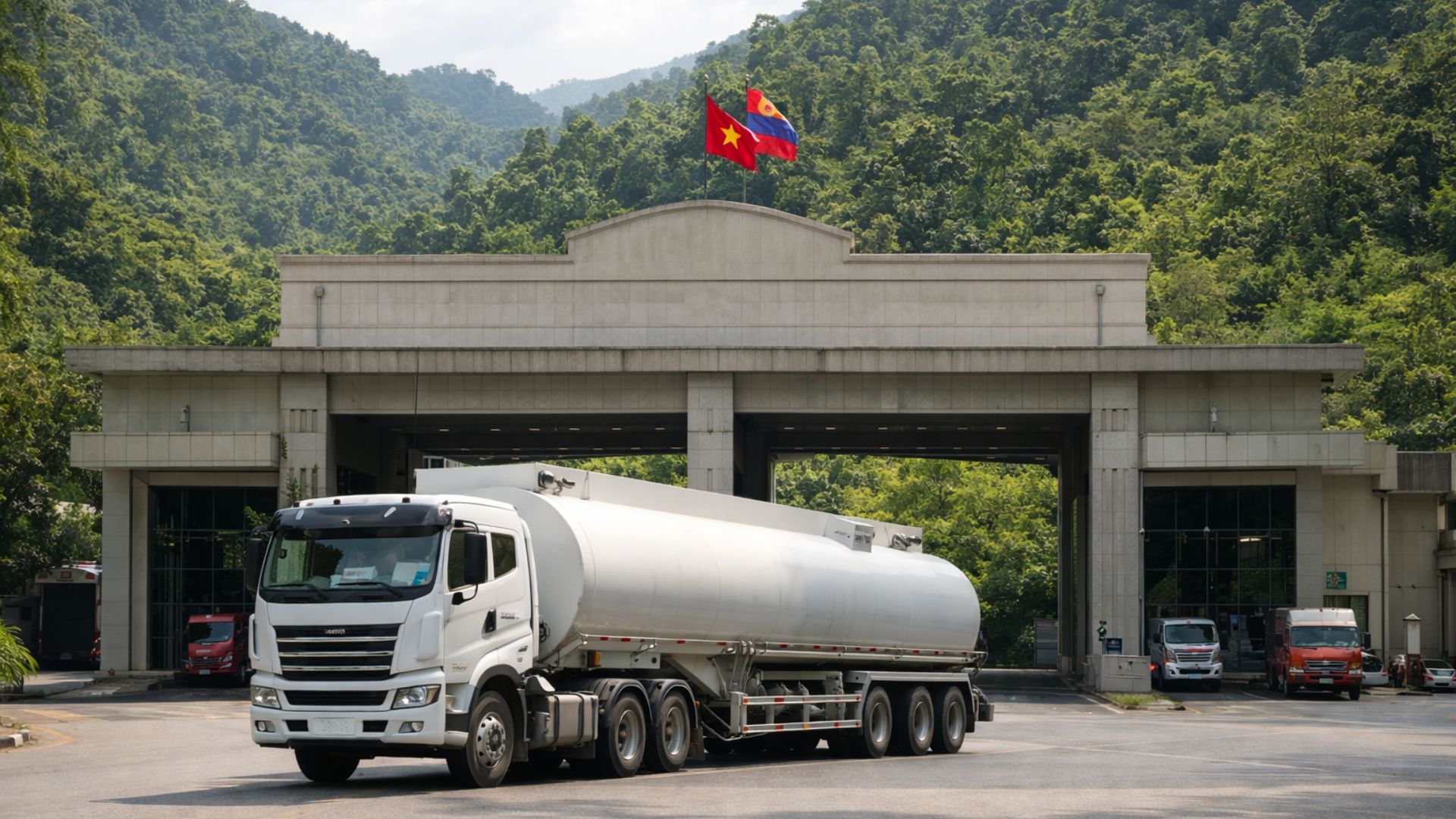







Vietnam assigned a state fuel company on March 21, 2026 to deliver 50 million litres of refined fuel directly to Laos, after Thailand reduced its exports to the landlocked nation by 25 percent amid the Strait of Hormuz disruption. The agreement, sealed in Hanoi on March 20 by the two countries’ ministers of industry and commerce, also expanded bilateral energy ties and established a framework for Laos to transit third-country fuel through Vietnamese territory.
Key Facts At A Glance
- Lao Minister of Industry and Commerce Malaithong Kommasith and Vietnamese Acting Minister Le Manh Hung sealed the fuel supply deal in Hanoi on March 20, 2026
- Vietnam assigned a state fuel company to deliver 50 million litres to Laos directly, effective March 21
- Thailand reduced fuel exports to Laos by 25 percent to 5.29 million litres per day, confirmed by Thai Prime Minister Anutin Charnvirakul on March 21
- Thailand supplies over 97 percent of Laos’ refined fuel under normal conditions; Laos was Thailand’s second-largest oil export destination in 2025 by volume
- As of March 21, 144 of 255 petrol stations in Vientiane Capital remained operational
- Vietnam also agreed to purchase increased electricity from Laos as part of the broader bilateral package
- Both countries agreed to develop cross-border fuel storage facilities, pipelines, and power transmission infrastructure along their shared border
A Fuel Crisis Rooted In Near-Total Import Dependence
Laos imports all of its refined petroleum products. It has no domestic refinery. In 2024, Thailand supplied approximately 94 percent of Laos’ fuel imports by volume, with Vietnam accounting for roughly 4 percent and Singapore and China making up the remainder. That dependency structure left Laos with almost no buffer when Thailand suspended all refined oil exports on March 1, exempting only Laos and Myanmar from the ban in recognition of long-standing bilateral energy ties.
Even with the exemption, the situation deteriorated rapidly. By March 11, government data confirmed that 1,068 of Laos’ 2,538 fuel stations nationwide had shut, approximately 42 percent, with the transportation, logistics, and agriculture sectors among those most affected. In Vientiane Province alone, 121 of 207 stations closed. Xieng Khouang Province reported that 121 of 153 stations were non-operational. Diesel prices rose by nearly 50 percent to 31,560 kip per litre, and hours-long queues formed at open stations across the capital. The government ordered nationwide fuel inspections on March 13 after finding that closures were occurring even where stock levels were reportedly adequate, suggesting distribution failures and possible market withholding alongside genuine supply shortfalls.
Thailand’s Position And The Mutual Energy Dependency
Thai Prime Minister Anutin Charnvirakul justified the continued, if reduced, supply to Laos by citing the countries’ mutual energy dependence. Laos is a net electricity exporter, earning the designation the Battery of Southeast Asia for its extensive hydropower network along the Mekong River and its tributaries. Thailand is Laos’ primary electricity buyer, with long-term power purchase agreements underpinning a significant share of Laos’ hydropower revenue. Disrupting fuel exports to Laos entirely would risk destabilizing grid operations at hydropower facilities that depend on diesel for auxiliary and emergency systems, which would in turn affect Thailand’s own power import volumes.
Anutin confirmed on March 21 that Thailand’s exports to Laos would continue at 5.29 million litres per day, down from previous levels, and that Myanmar would continue to receive 300,000 litres per day, a 20 percent reduction. Both carve-outs were described as reflecting existing energy interdependencies rather than purely humanitarian considerations.
The Vietnam Agreement And Its Wider Terms
The March 20 ministerial meeting in Hanoi produced a package that extended beyond the immediate fuel delivery. Vietnam agreed to allow Laos to transit refined petroleum products from third countries through Vietnamese territory, a provision that could reduce Laos’ structural dependence on the single Thai supply corridor. Both sides also agreed to expand cross-border power infrastructure and to develop shared fuel storage facilities and pipelines along the Lao-Vietnamese border to lower transport costs and improve supply resilience.
On the electricity side, Vietnam committed to purchasing increased volumes of electricity from Laos. This element of the agreement reinforces an existing framework: Vietnam’s Ministry of Industry and Trade had previously approved an electricity import price framework targeting up to 5,000 MW of imports from Laos by 2030 under the National Power Development Plan 8. Vietnam’s own power system faces seasonal demand peaks during the dry season, and Lao hydropower imports provide flexible baseload support for the northern grid. The fuel-for-electricity structure emerging from the March 20 agreement reflects the asymmetric but complementary positions of the two economies: Laos holds exportable hydropower; Vietnam holds refinery and import capacity.
The broader bilateral trade targets set at the meeting — USD 5 to 10 billion by 2030, supported by the Vientiane-Hanoi expressway and a railway linking Laos to Vietnam’s Vung Ang port — frame the fuel deal within a longer-term connectivity agenda that has direct implications for energy supply chain routing in the sub-region.
Open Questions On Supply Adequacy
The 50 million litres committed by Vietnam, while a practical intervention, does not resolve Laos’ structural supply problem in the medium term. Prior to the crisis, Laos was importing roughly 163 million litres per month on average, based on 2025 data. The Vietnamese commitment represents approximately one-third of a normal monthly supply. The arrangement with Thailand, now reduced by 25 percent, provides the remainder at reduced volumes. Whether the combined supply from Thailand and Vietnam is sufficient to reopen closed stations and stabilize retail markets will depend on distribution logistics, the pace of delivery, and whether fuel station closures linked to market withholding rather than pure scarcity can be addressed by the government’s special oversight committee.