

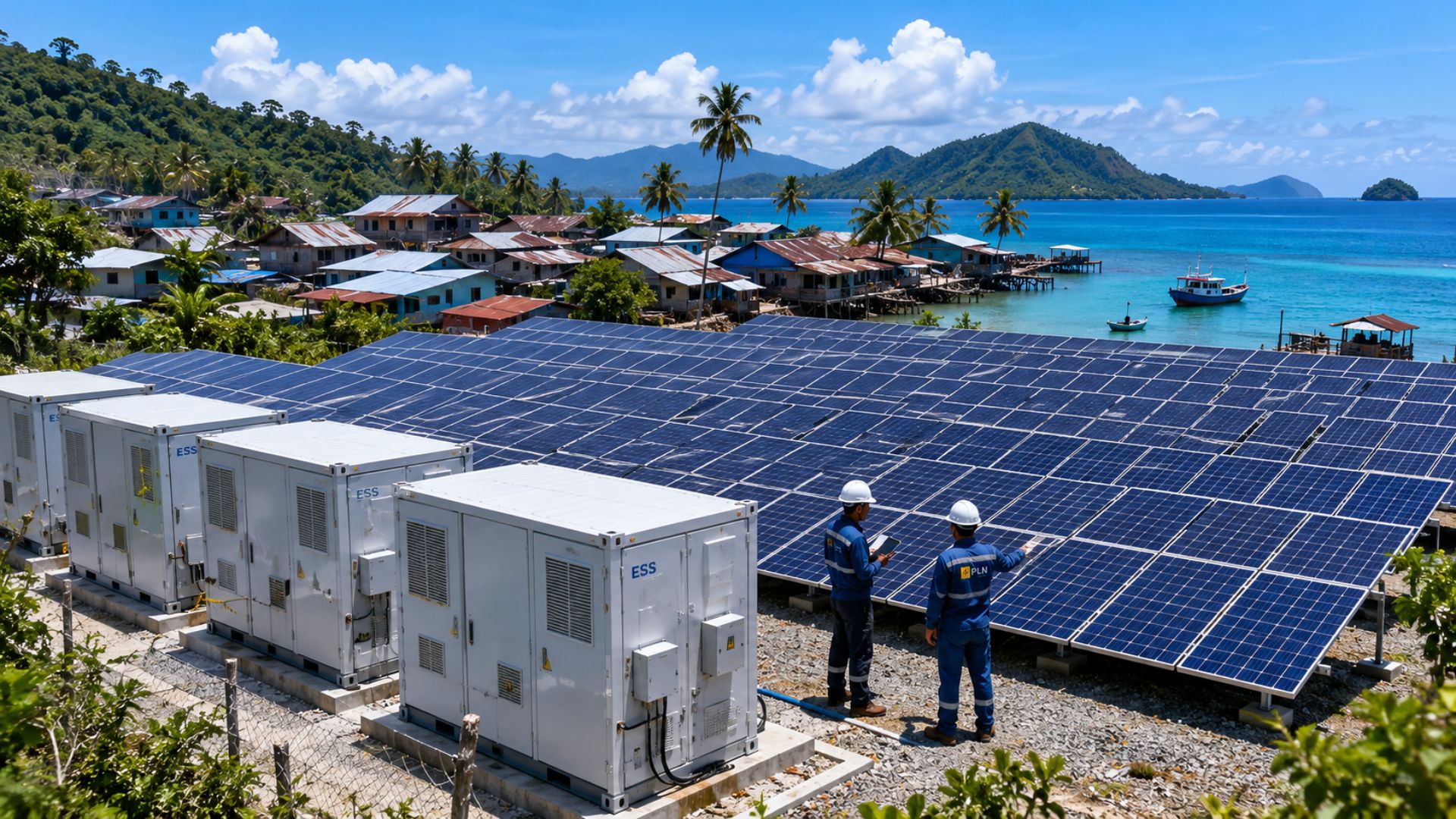







Indonesia’s government and state utility PT Perusahaan Listrik Negara are pressing forward with an ambitious 100-gigawatt solar power and battery storage program aimed at ending the country’s reliance on diesel generation in remote and island regions, as the ongoing Middle East supply disruption has sharpened the economic and strategic case for the transition.
The program, first announced by President Prabowo Subianto in August 2025, targets full deployment across Indonesia’s archipelago of over 17,000 islands, with an initial priority phase targeting 13 GW of solar plus battery energy storage systems to replace the costliest and most import-dependent diesel plants. The Hormuz closure has added urgency: diesel generation costs in Indonesia already ranged between USD 0.37 and USD 0.57 per kilowatt-hour between 2020 and 2023, and analysts at the Institute for Energy Economics and Financial Analysis have warned that current market conditions are likely to keep diesel costs at or above 2023 peaks for the foreseeable future.
Key Facts At A Glance
- Indonesia operated approximately 5.8 GW of grid-installed diesel power capacity across thousands of units as of 2024, with PLN owning around 3 GW of that total
- PLN’s diesel fleet consumes an estimated 2.7 billion liters of high-speed diesel annually, requiring around 17 million barrels of imported fuel at a cost of over USD 2 billion per year
- Solar plus BESS can deliver power at USD 0.08-0.20 per kWh versus USD 0.29-0.65 per kWh for diesel, according to IEEFA
- The IEEFA estimates full diesel replacement would generate USD 2 billion in avoided import savings and USD 1.5-2 billion in reduced subsidy outlays annually
- The 100 GW plan far exceeds PLN’s existing RUPTL 2025-2034 blueprint, which targets a more gradual expansion of around 17.1 GW in additional solar by 2034
- Despite a Diesel Replacement Programme launched in 2022, no power purchase agreements have been signed to date under that initiative
- USD 1.4 billion in foreign direct investment has been committed for a domestic solar panel factory with up to 50 GW production capacity, targeted for completion by end-2026
- Around 5,700 villages across Indonesia currently remain without electricity access
The Diesel Dependency Problem
Indonesia’s geography has long made diesel the default solution for remote electrification. Extending transmission lines across thousands of dispersed islands was impractical for decades, so successive governments defaulted to deploying diesel generators in island communities despite high fuel costs, complex logistics, and chronic subsidy burdens. PT PLN owns and operates approximately 3 GW of this diesel capacity, producing over 7,000 gigawatt-hours annually. Total national diesel generation capacity, including captive systems, reached approximately 5.8 GW as of 2024.
The financial exposure is substantial. PLN spent over USD 2 billion annually on diesel imports in recent years, a figure compounded by fuel subsidy obligations that reached USD 11 billion in total PLN subsidy and compensation payments in 2024. Diesel generation costs have swung violently with global oil prices, climbing from IDR 4,746 per kilowatt-hour in 2020 to IDR 8,748 per kilowatt-hour in 2023. With the Strait of Hormuz effectively closed to commercial shipping since late February 2026, Indonesia’s oil import dependency has become a front-line energy security vulnerability rather than a theoretical risk.
The 100 GW Program: Structure And Priorities
President Prabowo’s directive, formalized in mid-2025 and given an implementation framework by the Institute for Essential Services Reform in collaboration with the Coordinating Ministry for Economic Affairs in February 2026, envisions deploying approximately 80 GW of decentralized solar plus BESS across Indonesia’s roughly 80,000 villages and a further 20 GW of centralized utility-scale solar. Initial deployment strategy focuses on a 13 GW priority phase in areas where electricity distribution infrastructure already exists, to allow for faster grid integration and commercial operation.
Energy and Mineral Resources Minister Bahlil Lahadalia confirmed in March 2026 that the program’s operational logic is sequenced: solar plants must reach commercial operation before diesel generators are shut down, rather than following a simultaneous decommissioning approach. President Prabowo, speaking on April 9 at an electric vehicle plant inauguration in Magelang, Central Java, stated the program could reduce fuel imports by up to 200,000 barrels per day, equivalent to around 20% of Indonesia’s total oil import volumes. An Energy Transition Acceleration Task Force, chaired by Bahlil, was established earlier this year to oversee implementation.
The program’s scale significantly exceeds Indonesia’s existing power system planning documents. PLN’s RUPTL 2025-2034 targets only around 17.1 GW of additional solar capacity by 2034, meaning the 100 GW initiative requires regulatory and procurement structures that lie well beyond the current planning framework.
Regulatory Gaps And Implementation Delays
The program’s ambition sits in direct tension with a track record of implementation delays. PLN launched its Diesel Replacement Programme in March 2022 with the aim of converting approximately 5,200 diesel plants to renewable-based generators. As of April 2026, no power purchase agreements have been signed under that initiative. Presidential Regulation PR 112 of 2022 set procurement timelines of under 180 days, but those timelines have not been met.
The Ministry of Energy and Mineral Resources addressed one gap with Regulation No. 19 of 2025, which established a formal framework for hybrid power plants in small islands and isolated areas, allowing PLN to operate hybrid diesel-solar-storage systems. However, the tariff framework for these configurations remains under discussion. Without finalized tariff structures, PLN cannot execute power purchase agreements, and private developers cannot model bankable investment cases. The IEEFA’s Indonesia analyst Mutya Yustika has stated publicly that the tariff gap is the primary structural barrier to mobilizing private capital.
Additional barriers identified across multiple analyses include land acquisition complexity across dispersed islands, local content requirements that raise project costs, regulatory uncertainty around whether BESS configurations fall under existing renewable energy PPA regulations, and a geographic mismatch between Indonesia’s largest renewable resource zones and its major demand centers.
The Investment Case And Financing Requirements
IEEFA estimates that replacing diesel with solar plus BESS across PLN’s island fleet would require USD 15-19.5 billion in private capital for the initial 13 GW phase alone. Total program investment through 2030 under the IESR’s dual-track deployment framework is estimated at USD 51-78 billion, with full 100 GW deployment requiring an additional USD 140-210 billion beyond that. The Regulatory Assistance Project and IESR have jointly proposed a 180-day action plan to operationalize the program, including regional project clustering to create investment packages large enough to attract institutional capital, integration of blended finance instruments, and procurement process streamlining.
On the supply side, Indonesia is pursuing domestic manufacturing capacity. Danantara CEO and Investment Minister Rosan Roeslani confirmed in March that USD 1.4 billion in foreign direct investment has been committed to a local solar panel factory targeting up to 50 GW annual production capacity, with completion targeted by end-2026. The facility is intended to reduce reliance on imported components and potentially position Indonesia as a regional solar manufacturing hub.
Middle East Crisis As Accelerant
The Strait of Hormuz disruption since late February 2026 has added a geopolitical dimension to the economic case. Indonesia, as a major oil importer, has been directly exposed to the supply shock. Bahlil confirmed in late April that Indonesia stopped importing low-grade diesel this year under the B40 biodiesel program, and the government is accelerating the B50 mandate to July 1, 2026 as a near-term hedge. But the broader structural vulnerability remains: Indonesia’s island power systems are still tied to imported petroleum, and no permanent alternative procurement has been completed.
A ECADIN and PPI Dunia Policy Dialogue held in Jakarta on May 13 also examined the 100 GW program’s classification structure, noting that around 30.5 GW is already incorporated in the RUPTL 2025-2034, with the remainder requiring new policy frameworks and investment mobilization channels outside existing planning instruments.