

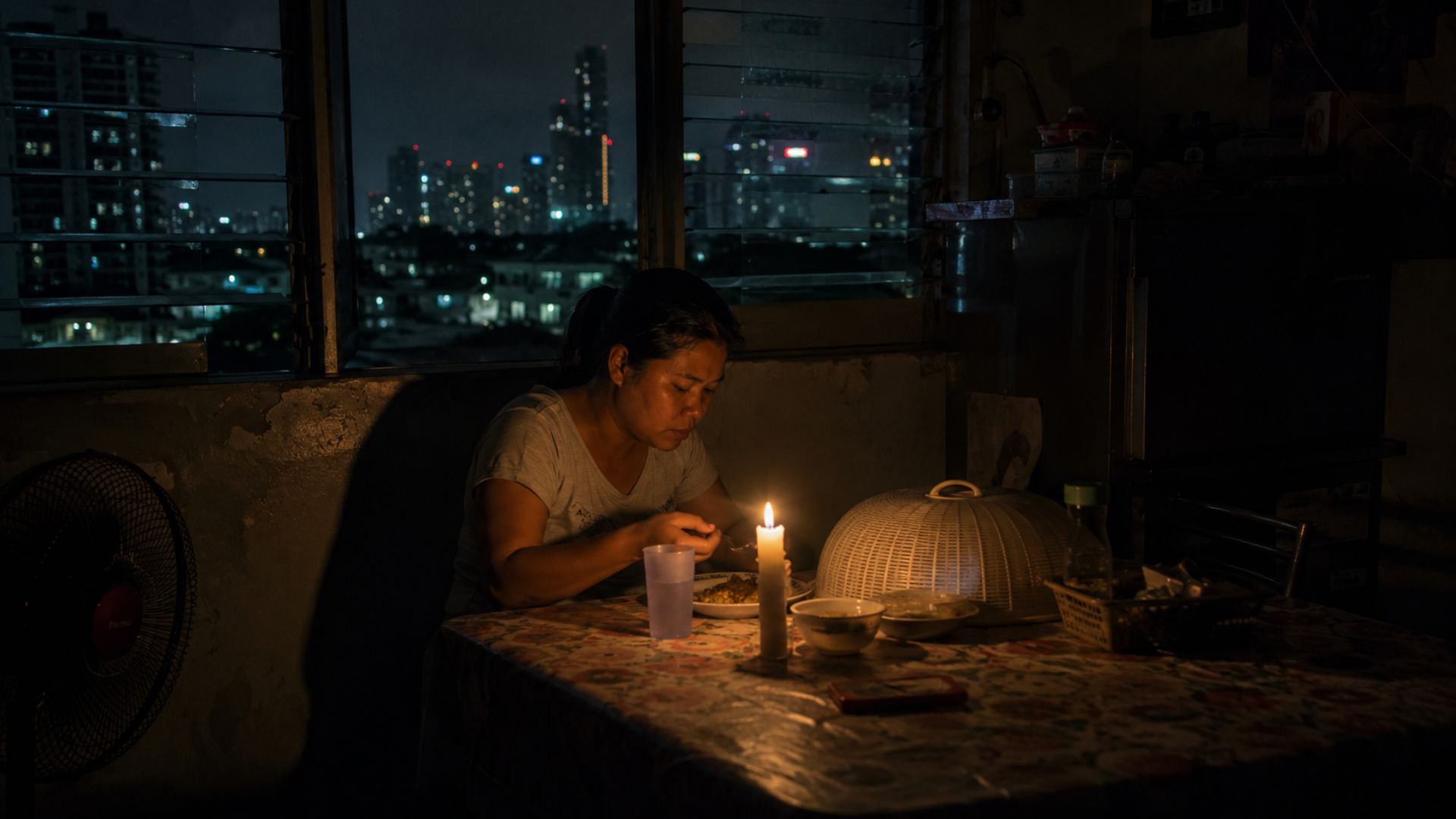







Three days. Nearly three million customers. And no end in sight.
The brownouts that have darkened homes and disrupted businesses across Metro Manila and surrounding provinces this week did not arrive without warning. They arrived, instead, as the predictable consequence of a perfect collision — a power grid already strained by aging and malfunctioning plants, meeting the peak heat of the Philippine summer.
It started on Tuesday, May 13.
The crisis was set off by the tripping of the 500-kilovolt Tayabas-Ilijan and Dasmariñas-Ilijan transmission lines. The failures sent shockwaves through the Luzon grid. By afternoon, peak demand had reached 12,537 megawatts, surpassing available capacity of 12,447 megawatts, while a total of 4,681.6 megawatts had become unavailable to the grid.
The National Grid Corporation of the Philippines (NGCP) placed the Luzon grid under yellow alert from 2 p.m. to 3 p.m., then escalated to red alert from 3 p.m. to 8 p.m., before reverting to yellow alert from 8 p.m. to 10 p.m. Red alert is the highest level — the point at which the grid can no longer supply what the country demands, and rolling blackouts become the only tool left to prevent a total collapse.
At 3:23 p.m., Meralco began implementing emergency manual load dropping, rotating power interruptions that lasted an average of three hours across parts of Batangas, Bulacan, Cavite, Laguna, Metro Manila, and Rizal. By nightfall, the numbers had climbed sharply. Nearly 1.9 million customers in portions of Bulacan, Cavite, Laguna, Metro Manila, Quezon, and Rizal had lost power — roughly 23 percent of Meralco’s 8.3 million customer base. Electricity service was fully restored only by 12:14 a.m. the following day.
Wednesday brought no relief.
As of its 8 a.m. advisory on May 14, NGCP reported that 14 power plants were running on derated capacities, making around 4,200 megawatts unavailable to the grid. Power demand in Luzon was estimated to peak at 12,595 megawatts, against an available capacity of only 12,479 megawatts.
Meralco rotated the outages in stages through the afternoon and evening — moving from Cavite into Metro Manila, then into Marikina, Muntinlupa, and portions of Rizal, and later extending into Silang and Tagaytay, Laguna, and Quezon Province. By 7 p.m., over 320,000 customers in parts of Bulacan, Cavite, Laguna, Metro Manila, Pampanga, Quezon, and Rizal had been affected. In Sampaloc, Manila, a resident ate dinner by candlelight.
Energy advocacy groups were quick to point out that 72 percent of the lost capacity came from coal and gas plants — notably the Ilijan gas plant units, each rated at 600 megawatts. They noted that the rolling blackouts were not mere inconveniences, warning that they disrupt livelihoods, endanger senior citizens, children, and the ill, affect students and workers, and threaten the operations of hospitals, transportation systems, and essential services.
On both days, Meralco activated its Interruptible Load Program, calling on large commercial and industrial customers to switch to their own generator sets. The program secured a collective de-loading capacity of around 270 megawatts.
Department of Energy Secretary Sharon Garin directed the NGCP to immediately resolve the transmission constraints affecting the dispatch of large power plants, and ordered the San Miguel Power Group to restore its affected Masinloc unit.
By Friday, May 15, the situation had not improved. Meralco’s 8 a.m. advisory confirmed that NGCP had again raised yellow and red alerts due to low power supply and reserves from Luzon power plants — with red alert expected between 3:01 p.m. and 10 p.m. Seven tentative manual load dropping events were being prepared for the day.
The Luzon grid’s last red alert before this week was on June 1, 2024. The country recorded only nine yellow alerts in all of 2025. Three consecutive days of red alerts in May 2026 mark a significant deterioration in grid stability — one that experts and consumer groups say reflects years of deferred maintenance and an over-reliance on fossil fuel plants that are already showing their age in the worst heat of the year.
For millions of Filipinos sweating through another summer night, the explanation matters less than the outcome. The lights are out. And no one can say with certainty when they’ll stay on.